
Springville Resident Lookup Coverage
A careful Springville resident lookup separates ownership, registration, court activity, vital events, and professional or business identity. The county Assessor can show the owner and tax mailing address tied to a parcel. A voter result concerns registration and election geography. Xchange concerns a public case index. A vital certificate uses eligibility rules. DOPL and business filings corroborate a credential or organization, not residence.
| Record | What It Confirms | Where to Search | Access |
|---|---|---|---|
| Property roll | Owner, parcel, mailing address | Utah County Assessor | Free online route |
| Voter registration | Status, districts, registration address | Utah Vote / County Elections | Privacy and use rules |
| Court records | Case, party role, dates, documents | Utah Courts Xchange | Paid account or clerk route |
| Vital records | Birth, death, marriage, divorce evidence | OVRS, County Clerk, court | Threshold and eligibility rules |
| License or entity filing | Credential or business association | Utah DOPL / Commerce | Free search; details vary |
Start with the strongest detail in hand. Use an address for the Assessor, a case number for Xchange, an event and relationship for vital records, or a license number for DOPL. If the question is historical, begin with the Herald, cemetery, directory, Archives, or FamilySearch rather than expecting a current lookup to reach an earlier household.
Verifying a Springville Resident
A name match is only a starting point. In a Springville resident lookup, compare the person’s name with an address, parcel serial, filing date, case number, plot, or family link. Search common spelling variants. Xchange names are entered as received, and its wildcard behavior can broaden a search, but broad results are capped at 500. The local Springville Justice Court code is SV3, not a residence marker.
- Anchor the name to an address, parcel serial, date, or family connection in a lawful source.
- Run Xchange by jurisdiction, case type, name variant, case number, citation, or date range.
- Compare the result’s court, county, party role, filing date, and birth date when available.
- Use the correct vital-record custodian and request a certified copy only when eligibility supports it.
- Docket
- The dated case history of filings, hearings, parties, orders, and other events.
- Index versus image
- An index points to a record; an image is the document view, and a formal copy may cost more.
- Certified copy
- A custodian-attested copy issued under that office’s identity and access rules.
Xchange Results in Springville
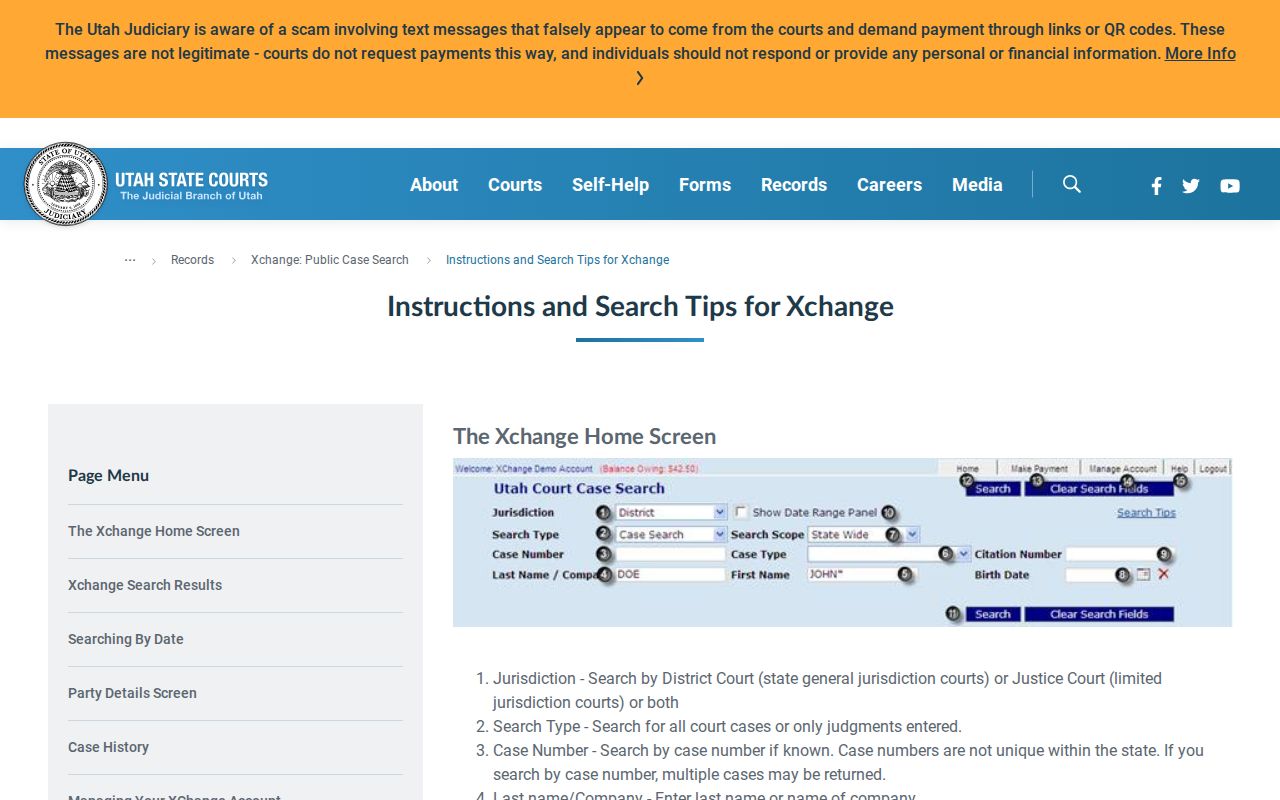
The Utah Courts Xchange help page lists fields for jurisdiction, search type, case number, last name or company, first name, case type, scope, birth date, citation, and date range. Results can show county, court location, case type, case number, filing date, party name, party code, history, documents, and sometimes an address from the public case.
History may include charges, pleas, dispositions, judgments, hearings, judges, events, and document links. A party code such as PLA, DEF, PET, or RES describes a case role. A result does not prove guilt or a current Springville address. Documents cost $1 regardless of page count, and account searches have their own charges. Public terminals at district courthouses provide another access route.
The Xchange field guide records the narrowing controls that make a name search more useful.
Sealed, private, juvenile, adoption, expunged, and other protected cases can be absent by design.
Utah Vote Status Fields
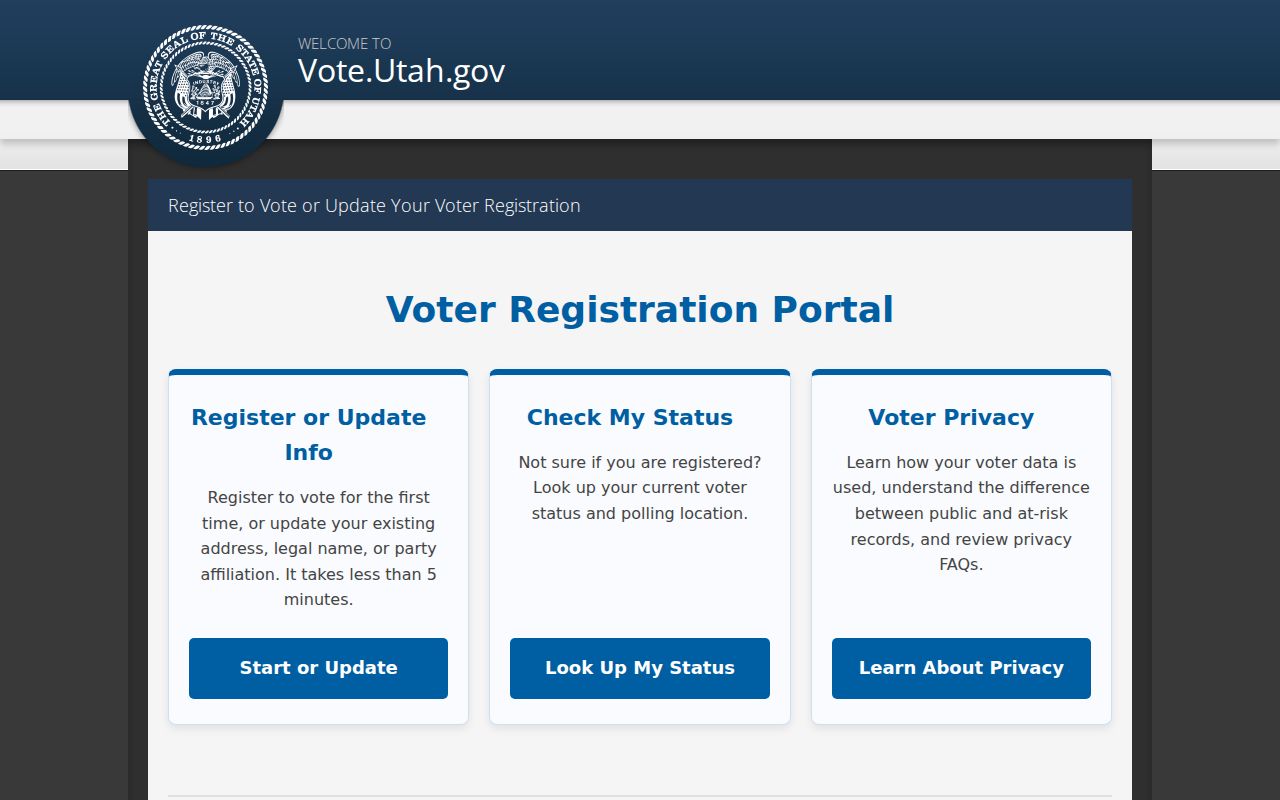
The Utah Vote registration page joins status, address-update, party, and polling workflows. A public standard file can include full legal name, voter ID, age range, residential and mailing address, precinct, districts, party, active or inactive status, last update, and vote history. It does not show how a person voted.
Full birth date, driver-license or state-ID data, Social Security number, email, and phone are private. An at-risk voter can be withheld or anonymized. A registration address is a dated election record, so use it as one part of a Springville resident lookup rather than a guarantee of current occupancy.
The Utah Vote workflow is the official status and polling route for a Springville resident lookup.
Vital Events Need Eligibility
Birth, death, marriage, and divorce routes do not function as an open resident lookup. Utah OVRS uses statutory thresholds and qualifying interest. Utah County Clerk handles the marriage application, while a divorce decree is a District Court file. The marriage or divorce request form asks for event details, relationship, ID or proof, copies, signature, and payment.
Historical alternatives include the FamilySearch Utah County collection, State Archives, the Herald, cemetery records, and probate. A death record is public after 50 years, birth after 100, and other vital events after 75 under Utah Code §26B-8-125. Newer copies need a qualifying direct tangible legitimate interest or another allowed route.
Utah Vital Records is the official starting point for a certificate request or eligibility check.
MyCourtCase and the Local Clerk
Springville’s MyCourtCase service is a free route for a registered user’s accessible cases. Setup can use an email, case number, government ID, or court email arrangement. It may show case history, filed papers, minutes, hearing notices, treatment updates, and a balance. Uploaded papers are reviewed before they become official.
That service is not a public name directory. For a local file, question, certified copy, or older material, contact the Springville Justice Court clerk at 110 S Main, 801-489-2707. Clerk hours are Monday through Friday, 8 to 5; the payment counter closes at 4:30. Judge appointments are Tuesday through Thursday.
Historical Identity Leads
When a resident lookup concerns an ancestor, heir, classmate, or former neighbor, the strongest evidence may sit outside a current roll. Search the Springville Herald from 1924 to 2008 by name and date. Test a match in the cemetery GIS and the city ledger. FamilySearch’s Utah County collection includes historical births, deaths, marriages, deeds, naturalization, and other records, while the probate collection covers 1851 to 1961 and can identify heirs.
Utah State Archives indexes allow name or keyword searches, surname-first browsing, series inventories, image links, and order or email routes. The 1950 Census is the last currently public federal census in 2026. A directory, census, newspaper, and parcel record with the same date and place are stronger together than a lone name hit.
Narrow Corroboration Sources
DOPL’s current license lookup can search by name and profession or by a core license number paired with a four-digit identifier. Results show name, profession, license number, and expiration. The data note is current as of August 31, 2026. A DOPL result can confirm a professional record, not a Springville residence. Commerce’s Business Entity Search and Registered Principal Search can connect a person to an organization or filing trail, but not to every person at an address.
Utah County Sheriff’s inmate search covers current and past inmates from the last two years by name and arrest date. UDC Offender Search covers people currently under state supervision. Neither is a complete history or a current address source. Use these narrow tools only when the record category fits the question.
Limits on a Springville Resident Lookup
Utah’s GRAMA law gives people a right to inspect or copy public records unless a classification applies. It does not open every personal field. Voter rules protect full birth date, driver-license and state-ID data, Social Security number, email, phone, and at-risk identities. Vital records have their own 100-year birth, 50-year death, and 75-year other-event thresholds. Court rules close sealed, private, juvenile, and expunged material.
Lawful use. A Springville resident lookup is for lawful personal, family-history, estate, or civic research. Do not use a record to stalk, harass, threaten, or expose a protected person.
Utah Safe at Home gives eligible survivors a substitute legal address and protects the actual location, mail, city, county, precinct, phone, and unique identifiers. If a name disappears, the correct result may be “not publicly available.” Contact the custodian to correct a wrong record rather than trying to reconstruct a protected one.